Applied Behavior Analysis (ABA) therapy is a structured approach that aims to support individuals with autism in learning and acquiring new skills. This therapy utilizes a prompt hierarchy, carefully designed to foster independence and empower individuals on the autism spectrum. By fading prompts from most to least intrusive, ABA therapy prioritizes the individual's autonomy and recognizes disability as a social construct.
This article explores the different types of prompts used in ABA therapy, the process of assessing and adjusting prompt levels, the strategies employed in prompt fading, and the challenges of prompt dependency and skill generalization. Additionally, it discusses the importance of implementing generalization strategies and best practices for effective prompting in ABA therapy. Through a comprehensive and respectful approach, ABA therapy aims to support the diverse needs and rights of individuals with autism, providing valuable insights and empowering parents with expert advice.
Applied Behavior Analysis (ABA) therapy employs a well-structured prompt hierarchy to facilitate learning and acquisition of new skills in individuals with autism. This hierarchy is carefully established with an understanding of disability as a complex social construct, not merely a medical deficit. Acknowledging the impaired function, ABA therapy aligns with the social model of disability, advocating for societal change rather than solely focusing on the individual's adaptation.
Within the ABA framework, from most to least intrusive to encourage independence. The approach is deeply rooted in respect for the individual, recognizing disability as part of one's identity and advocating against ableism and discrimination. This outlook resonates with the critiques from the autism community, emphasizing the need for interventions that truly respect the diversity and rights of individuals on the autism spectrum.
The prompt hierarchy is designed to evolve over time, mirroring the principles of the social model that suggest adjustments in the environment and societal attitudes rather than solely in the individual. By minimizing the reliance on prompts, ABA therapy aims to empower individuals, allowing them to navigate the world on their terms.
Such a thoughtful approach to therapy is in line with the recommendations from the IACC, which stress the importance of understanding the full diversity of the autism spectrum and developing interventions that maximize positive outcomes. Through systematic assessments that identify individual strengths and challenges, ABA therapy is tailored to each person's unique needs. This data-driven method, endorsed by both research and the experiences of those within the autism community, underlines the significance of a comprehensive, respectful, and adaptive treatment strategy that truly supports the individual's growth and well-being.
utilizes a variety of prompts to facilitate skill acquisition in individuals with autism. These prompts, ranging from physical to visual, are not one-size-fits-all but are carefully chosen to align with the individual's unique learning style and level of independence.
Therapists meticulously assess the individual's strengths and challenges, ensuring that the prompts enhance learning while respecting the person's autonomy. With the ultimate goal of fostering independence, therapists systematically reduce the level of prompting, adjusting their strategies based on ongoing data analysis and the evolving needs of the individual.
Moreover, the integrity of ABA interventions, underscored by evidence-based methods, calls for a nuanced understanding of prompt selection and application, ensuring they are beneficial and do not inadvertently cause harm. As such, therapists are encouraged to build rapport with parents, actively listen to their concerns, and establish trust, ensuring a collaborative approach to the child's development.
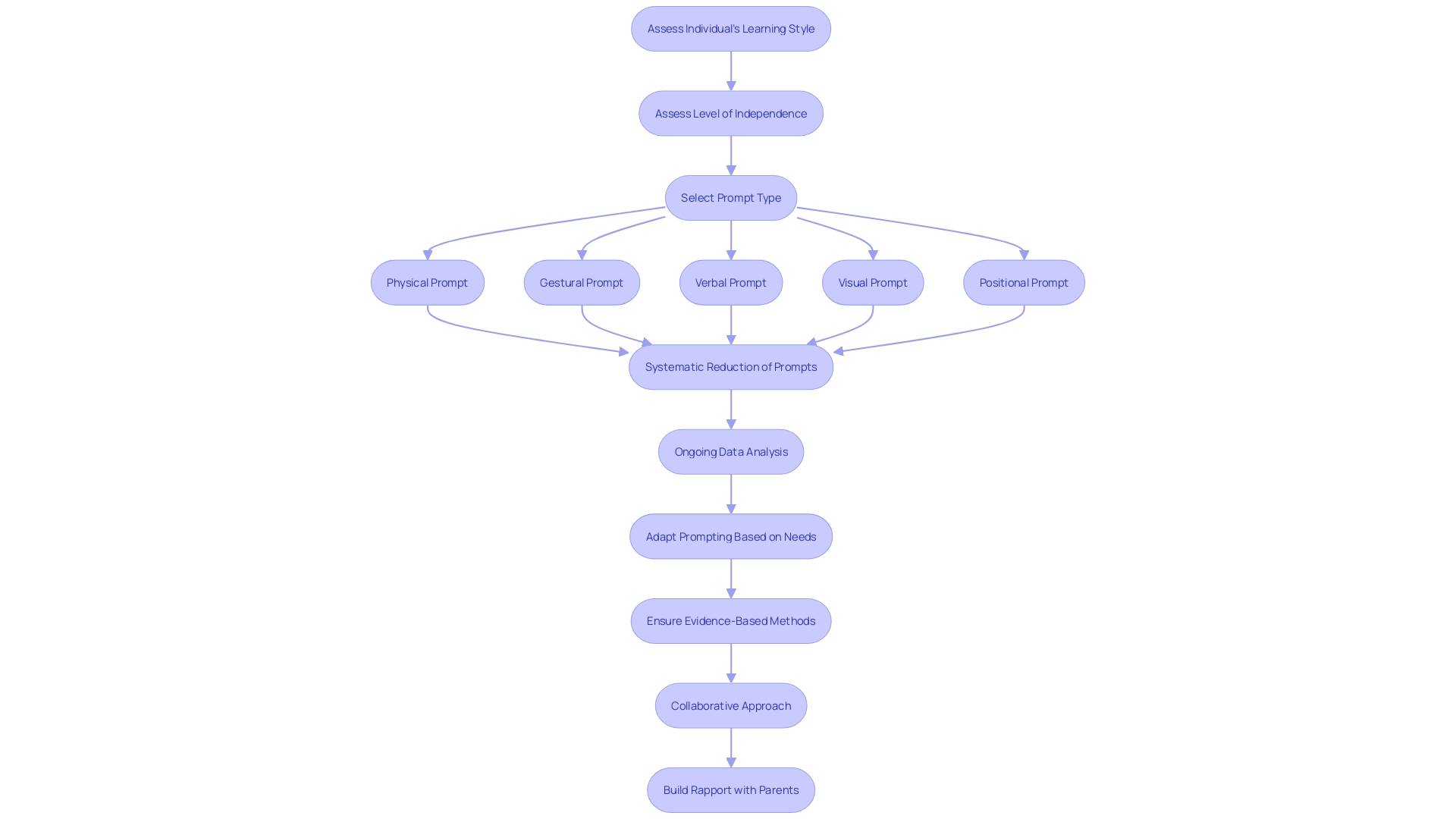
The practice of Applied Behavior Analysis (ABA) hinges on tailoring interventions to each individual's unique skillset and abilities. This personalized approach is particularly significant given the diversity within the autism spectrum. Dr. Jan Blacher, a distinguished researcher, has observed a shift in the demographic of autism diagnoses, noting, "Instead of just thinking of autism as individuals with an intellectual impairment... we had a lot of children that were very bright..." This evolution underscores the necessity for ABA therapists to meticulously gauge the least intrusive prompt necessary for effective learning.
Prompt levels are dynamic and must be adjusted as individuals advance in their skill acquisition, moving towards greater autonomy. The progression from more to less intrusive prompts is not a linear path but one that requires continuous assessment to foster skill generalization and independence.
The recently updated by the Council of Autism Service Providers stand testament to this, emphasizing the importance of high-quality implementation. As Lorri Unumb, CEO of CASP, stated, "ABA is a highly effective treatment for autism. But it has to be correctly implemented at the highest quality."
Furthermore, the social and cultural models of disability advocate for a more inclusive consideration of autistic individuals' needs. These models challenge the traditional view of disability, reframing it as a social construct that reflects broader societal attitudes and structures. By applying these perspectives, ABA can evolve to not only modify individual behavior but also to influence societal accommodations and respect for neurodiversity.
It is paramount, then, for ABA practitioners to involve individuals with autism in the treatment planning process, resonating with the call for respect and recognition as highlighted by both researchers and advocates within the autism community. This collaborative ethos ensures that ABA therapy remains a respectful, person-centered practice that values the individuality of each autistic person.
Prompt fading is a cornerstone technique in ABA therapy, integral in transitioning individuals from dependence on guidance to spontaneous, independent skill use. The concept hinges on the systematic withdrawal of assistance, which varies in form and intensity. For instance, an immediate physical prompt may be replaced by a subtler verbal cue or a gestural hint, progressively moving towards the least intrusive form or even eliminating the prompt entirely.
A nuanced understanding of this method is critical, as echoed by [Functional Analytic Psychotherapy](https://rori.care/post/10-effective-techniques-for-promoting-positive-social-interactions-in-asd) (FAP)—a contemporary behavioral approach—that emphasizes the importance of considering a client's history and environment when addressing behaviors. FAP rejects the idea that behaviors are symptoms of a disease, instead viewing them as logical responses to one's circumstances. This perspective aligns with prompt fading in ABA, where prompts are individualized and adapted based on the unique needs and experiences of the person receiving therapy.
The , such as time delay, stimulus fading, and hierarchy thinning, are more than mere procedural steps; they embody a deeper commitment to respecting and enhancing the autonomy of individuals with disabilities. The social model of disability reinforces this approach, recognizing disability as a result of social constructs and advocating for societal adjustments to support individuals rather than solely focusing on changing the person.
Recent news from the World Economic Forum underscores the urgency for rethinking skill development in our rapidly evolving societal context. As we face a global skills gap, with a predicted one billion people needing reskilling, the principles of ABA and FAP offer a blueprint for how we might support the learning process. The push for continuous learning and growth mindsets in the workforce, as highlighted by the CEO of Udao, mirrors ABA's emphasis on building and refining skills through adaptable and supportive interventions.
In this light, the process of prompt fading is not just a technical maneuver within therapy but a reflection of a broader societal and cultural shift towards empowering individuals through tailored support and learning opportunities—ultimately fostering a more inclusive and adaptive world.

Navigating the complexities of skill acquisition in ABA therapy, therapists face the dual challenges of prompt dependency and the generalization of skills. Prompt dependency is when a learner relies heavily on the prompts provided and finds it hard to perform the skill without assistance. On the other hand, generalization issues occur when learners are unable to transfer a newly acquired skill across different environments or to various people. To address these challenges, therapists can utilize , which involve gradually reducing the level of assistance until the learner can perform the skill independently. Moreover, by increasing task complexity and integrating generalization activities into the learning process, therapists can help learners apply their skills more broadly. These strategies are akin to an algorithmic approach where, much like machines learning new tasks, each step is fine-tuned to optimize performance and adaptability.
The concept of generalization transcends the traditional scope of ABA therapy by empowering individuals with autism to apply their learned skills across various environments and contexts. It's a transformative step from the controlled therapy setting to the unpredictable real world. To facilitate this, therapists can strategically teach in diverse settings, use an array of materials and stimuli, and engage multiple individuals in the learning process. The goal is to create a rich tapestry of experiences that enable individuals to adapt their skills to new and different situations. The social model of disability underscores the importance of this approach, recognizing disability as a product of social constructs and advocating for societal change rather than solely focusing on the individual's adaptation. With the , as noted by Dr. Jan Blacher, and the expanding understanding of the spectrum, it's crucial for interventions to evolve. Tailoring strategies to meet the varied needs of individuals, as echoed by Doreen Granpeesheh, CEO of the Center for Autism and Related Disorders, is essential in fostering a workforce that is both flexible and inclusive. Reflecting on these considerations allows for a more equitable and effective application of ABA therapy, one where the unique identity and rights of individuals with autism are respected and promoted.
When it comes to ABA therapy, the precision and adaptability of the approach are paramount. For each child on the autism spectrum, the therapy must be tailored, considering their unique abilities and needs. The recent guidelines set by the Council of Autism Service Providers illustrate this commitment, emphasizing high-quality, individualized treatment. The goal is to foster independence and skill acquisition, which requires therapists to employ the least intrusive prompt necessary and systematically decrease these prompts over time. This gradual reduction is supported by immediate positive reinforcement for correct responses and a thoughtful increase in task difficulty, aligning with the individual's learning pace.
Monitoring progress through meticulous data collection and analysis is equally essential. It allows for informed adjustments in prompting strategies, ensuring the child continues to advance towards their full potential. Research underscores the diversity within the autism spectrum, highlighting the need for such personalized interventions. With the , as Dr. Jan Blacher points out, the one-size-fits-all model is obsolete. Each child may present with varying levels of communication, interpersonal skills, and behavior patterns, necessitating a nuanced approach to ABA therapy. As we continue to grapple with the complexities of autism, it's clear that interventions must be as diverse and dynamic as the individuals they aim to support.
ABA therapy prioritizes independence and recognizes disability as a social construct. It utilizes a prompt hierarchy, fading from most to least intrusive, and various types of prompts to cater to individual needs. Prompt fading strategies, such as time delay and hierarchy thinning, are employed to enhance autonomy.
Challenges of prompt dependency and skill generalization are addressed through systematic fading techniques and increased task complexity.
ABA therapy emphasizes tailoring interventions to each individual's unique abilities and needs. Collaboration with parents is crucial for a collaborative approach to the child's development. The therapy aligns with the social and cultural models of disability, advocating for societal change.
ABA therapy aims to empower individuals by facilitating skill generalization across different environments. Strategic teaching, diverse materials and stimuli, and engagement with multiple individuals support this process.
Precision and adaptability are paramount in ABA therapy. High-quality, individualized treatment is emphasized, with a gradual reduction of prompts over time. Continuous assessment and data analysis inform adjustments in prompting strategies.
ABA therapy recognizes the diversity within the autism spectrum and the need for personalized interventions.
In conclusion, ABA therapy promotes independence and respect for individuals with autism. By tailoring interventions, involving parents, and focusing on skill generalization, ABA therapy supports the diverse needs and rights of individuals with autism. This comprehensive approach provides valuable insights and empowers parents with expert advice.
What is the prompt hierarchy in ABA therapy?
The prompt hierarchy in ABA (Applied Behavior Analysis) therapy is a well-structured system used to facilitate learning and skill acquisition in individuals with autism. It involves using prompts that are faded from most to least intrusive to encourage independence.
How does ABA therapy view disability?
ABA therapy views disability through the social model of disability, which sees disability as a complex social construct rather than just a medical deficit. It advocates for societal change to accommodate individuals with disabilities, rather than solely focusing on the individual's adaptation.
What are the different types of prompts used in ABA therapy?
The types of prompts used in ABA therapy include: Physical prompts (hands-on guidance), Gestural prompts (movements or gestures), Verbal prompts (words or sounds), Visual prompts (visual cues or pictures), and Positional prompts (arranging the environment or materials).
How are prompt levels adjusted in ABA therapy?
Prompt levels are adjusted dynamically as individuals progress in their skill acquisition. Therapists continuously assess the individual's needs and systematically reduce the level of prompting to foster skill generalization and independence.
What are prompt fading strategies?
Prompt fading strategies involve the systematic withdrawal of assistance, such as replacing a direct physical prompt with a more subtle verbal cue or gestural hint, and eventually eliminating the prompt entirely. Strategies like time delay, stimulus fading, and hierarchy thinning are used to respect and enhance the autonomy of individuals with disabilities.
What challenges do therapists face in ABA therapy regarding skill acquisition?
Therapists face challenges like prompt dependency, where a learner becomes too reliant on prompts, and generalization issues, where learners struggle to transfer skills across different environments or to different people.
How do therapists address prompt dependency and generalization issues?
Therapists address these issues by employing systematic prompt fading techniques and integrating generalization activities into the learning process. They gradually reduce assistance and increase task complexity to help learners apply their skills more broadly.
How is the concept of generalization applied in ABA therapy?
Generalization involves teaching individuals with autism to apply their learned skills across various environments and contexts. Therapists teach in diverse settings, use different materials and stimuli, and involve multiple individuals in the learning process to create a rich array of experiences for skill adaptation.
What are the best practices for effective prompting in ABA therapy?
Best practices for effective prompting include tailoring therapy to the individual's abilities and needs, using the least intrusive prompts necessary, systematically fading prompts over time, reinforcing correct responses immediately, and gradually increasing task difficulty. Monitoring progress through data collection and analysis is also essential for informed adjustments in prompting strategies.