Autism spectrum disorder (ASD) encompasses a wide range of communication abilities, and within this spectrum, nonverbal and nonvocal autism are particularly distinct. Understanding the differences between these two forms of autism is crucial for developing tailored communication strategies. Nonverbal autism refers to significant difficulties with spoken language, while individuals with nonvocal autism may have the ability to speak but often choose not to or exhibit limited verbal skills.
Recognizing these nuances is essential for empowering nonverbal and nonvocal individuals with autism and providing them with the support they need. This article aims to provide parents with valuable insights and expert advice on how to navigate the unique communication challenges faced by their children. By exploring various strategies, such as using nonverbal cues and gestures, incorporating visual aids, incorporating music and dance, utilizing communication devices and technology, creating a supportive environment, and seeking professional help and resources, parents can empower their nonverbal autistic children to communicate and thrive.
Autism spectrum disorder (ASD) encompasses a wide range of communication abilities, and among these, are particularly distinct. Nonverbal autism is characterized by significant difficulties with spoken language, while individuals with nonvocal autism may have the ability to speak but often choose not to or exhibit limited verbal skills. between these two can be critical for developing tailored .
For those with nonvocal autism, become vital. Elizabeth Bonker, herself a nonspeaking advocate, has founded Communication 4 ALL to champion the rights of over 30 million non speaking individuals with autism globally. The organization emphasizes the potential for nonspeakers to communicate by typing and is dedicated to raising awareness, empowering stakeholders, and fostering community alliances to ensure educational opportunities for this group.
Understanding is crucial when addressing . Speech involves the coordinated effort of the articulatory, laryngeal, and respiratory subsystems, which include the movement of the tongue, jaw, lips, the vocal folds, and the flow of air through the larynx. This intricate process requires precise timing across all systems, which can pose significant challenges for individuals with autism.
Real-world cases further underscore the importance of recognizing the of those with autism. A striking example is a non-speaking autistic teenager who, despite his severe behaviors, was able to express his pain by typing 'help me it hurts' using an alphabet toy. Such incidents highlight the profound need to reassess our understanding and support of nonverbal and nonvocal individuals.
In light of these insights, it's evident that recognizing and supporting the unique communication needs of children with autism is essential. Every smile, gesture, or attempt at communication, whether through technology-assisted means or otherwise, needs to be acknowledged and valued as part of their self-expression and connection with the world.

Understanding is crucial when connecting with children who have autism, especially for those who are nonverbal. encompass a range of physical expressions, including pointing, nodding, facial expressions, and , which can significantly aid in fostering understanding. These gestures serve as bridges to communication, offering alternative pathways for children to express themselves and engage with the world around them.
A profound example of this is the story of Joshua and his father, Mr. Harris, who utilized on an electronic tablet for communication. This approach not only facilitated a breakthrough in Joshie's ability to express himself but also underscored the potential of such technologies to transform lives. In fact, the funding and installation of 100 in Peterborough have proven to be a testament to the impact of integrating into communication strategies.
Moreover, the intricacies of speech production, which involve the coordination of the vocal tract, articulators, and respiratory system, can pose challenges for autistic children. does not rely on these complex mechanisms, thus offering a more accessible mode of expression. The importance of and physical cues was also highlighted in a heart-wrenching incident where a non-speaking autistic teenager conveyed his pain through an alphabet toy, moving everyone at a medical conference.
Research by Professor Vikram Jaswal and his team at the University of Virginia further solidifies the significance of nonverbal literacy in autistic individuals. Their 'Whac-a-Mole' inspired study demonstrated that non-speaking autistic participants could anticipate letter sequences, revealing their cognitive engagement with language despite their nonverbal status. Additionally, Gregory Tino's experience, as depicted in his writings, provides insight into the rich inner world of , challenging preconceived notions about their capabilities and intellect.
Public fascination with body language, as described in Julius Fast's book, has grown significantly, emphasizing the authenticity it brings to communication over verbal exchanges. This has vast implications for how we interact with and support nonverbal autistic children, recognizing that their gestures and expressions are not just behaviors but meaningful forms of communication that reveal their thoughts and emotions. With proper understanding and support, nonverbal children can find their voice through alternative methods, enriching their ability to connect and share with others.
Imitation can be a bridge to meaningful communication for children with autism who are nonverbal. When parents and caregivers reflect the actions and behaviors of these children, it does more than just encourage them to engage—it recognizes their way of expressing themselves and lends them a voice. This reflective practice is not just about copying gestures or movements; it's about entering their world and validating their form of communication.
Studies have shown that about one-third of autistic individuals do not develop , despite receiving speech-focused interventions. This doesn't indicate a lack of capacity for language but rather a need for .
In light of this, imitation becomes a tool for learning and interaction. For instance, a non-speaking autistic teenager once communicated his pain by using a preschool alphabet toy to spell out a cry for help, highlighting that behavior often mistaken for being 'just behavioral' can have underlying communicative intents. By imitating these expressions, caregivers signal to the child that their efforts at communication are seen and valued, potentially opening doors to further language development.
Moreover, helps in teaching new skills. For example, instead of insisting on verbal responses, can be more effective. These methods respect the child's current abilities and encourage growth at their own pace.
The use of with picture boards, has been described as 'life-changing' and can unlock the potential for children to . As one father of a non-speaking child put it, the 'biggest' moments come when we see our children finding ways to express themselves, showing us that with the right support, all children deserve a chance at a full and productive education.
Visual tools, such as , are not merely aids for communication with ; they are bridges to a world of interaction and self-expression. By presenting words, objects, or concepts through images, these tools offer a tangible and relatable means for children to grasp and convey their thoughts. The versatility of allows for their use in teaching , articulating needs and preferences, and nurturing .
This method echoes the way people navigate language barriers using visual or gestural cues to comprehend and connect, transcending the spoken word. In the realm of autism, where traditional educational approaches may falter, alternative visual methods such as comic books and digital storytelling resonate deeply, harnessing the visual strengths of these individuals. Studies show that autistic persons, regardless of speech ability, can engage with written language, challenging prior assumptions about their communicative capabilities.
This revelation underpins the potential of to unlock new avenues for learning and interaction. Empirical evidence suggests that when speech is unclear or absent, gestures and visual cues become integral to communication, underscoring the efficacy of using as semantic and syntactic supports. As we advance in our understanding of autism, it is imperative to recognize the profound impact can have on the lives of nonverbal autistic individuals, illuminating their inherent potential for language and connection.
For nonverbal autistic children, the ability to express themselves is crucial for their development and well-being. , with its series of gestures and hand movements, offers a bridge to communication, conveying words and ideas without the need for speech. Beyond this, , such as picture-based boards and electronic devices, extend this bridge, allowing children to articulate their needs, thoughts, and feelings in a manner that is accessible to them.
These tools not only facilitate communication but also honor the individuality of each child. For instance, a young person named Lil, preparing for a significant transition from special school to a new community-based environment in Southampton, UK, benefited from a . This method provided Lil with a platform to share her story, elevating her voice and agency during a period that can often be fraught with uncertainty for autistic individuals.
The of such technologies is echoed in the story of Joshie, a 10-year-old boy who began using pictures on an electronic tablet to communicate. His father witnessed this as a pivotal moment, recognizing the power of these tools to reshape educational expectations and unlock potential. The subsequent campaign led to the installation of 100 picture boards in Peterborough, illustrating the life-changing effects of .
These narratives underscore the importance of . As researchers and community members critically assess intervention studies and strive to improve their quality, the fundamental respect for autistic individuals remains a guiding principle. The shared experiences within the Deaf community, where communication barriers are navigated daily, further highlight the value of a supportive network and the rich tapestry of identity that emerges from overcoming such challenges.
It is through this lens of respect, support, and innovation in communication that we can truly empower nonverbal autistic children, enabling them to share their unique perspectives and become active participants in their communities.
For , play and can serve as vital gateways to communication. These activities, when aligned with the child's own interests, can create a nurturing space that fosters both communication and meaningful social exchanges. The use of toys, games, and social stories can be particularly effective in facilitating this engagement.
For instance, the minimally expressive humanoid robot KASPAR, part of the Aurora project, demonstrates the potential of assistive robotics in mediating . KASPAR has helped children with low-functioning autism, who typically do not engage with others, to initiate interaction with the robot and, crucially, with the adults present.
It is essential to recognize that speech is not the sole expression of language. Historical misconceptions have conflated the inability to speak with an absence of language capacity. However, alternative communication methods, such as sign language for the deaf, illustrate that with the right support, individuals can express complex thoughts and engage in communication.
Unfortunately, nonspeaking autistic individuals often lack access to , which hinders their opportunities for education, employment, and social interaction.
Embracing the also means acknowledging the authenticity of their expressions. Recent studies on the differentiation between genuine and posed smiles in social communication underscore the importance of recognizing true emotions. Genuine smiles, which include the involuntary contraction of eye muscles, are an indicator of , while posed smiles might not reflect genuine feelings.
can enhance our interactions with autistic individuals.
Moreover, it is critical to maintain a hopeful outlook on autism. As one quote suggests, "Every day brings a new beginning and a new ending." This mindset can empower families to approach each day as a unique experience, filled with the potential for progress and joy.
In supporting nonverbal children, it is paramount to and provides them with the tools they need to communicate and thrive.

Music and dance offer a unique avenue for autistic children, who may experience challenges with verbal communication, to express themselves in a meaningful way. For individuals on the autism spectrum, engaging in can be a key to unlocking and fostering connections without the need for words. It's not merely a matter of enjoyment; music and dance can serve as a bridge to , creativity, and emotional well-being.
The profound impact of music as a communicative tool is supported by and real-world applications. For instance, Plymouth Music Zone, an award-winning charity, has been a part of groundbreaking research that demonstrates the personal and social benefits of music for individuals, including those with autism. The charity's commitment to using music for inclusion and social change highlights the to reach and uplift vulnerable populations.
Similarly, the story of Jacob Rock, an autistic individual who, despite being nonverbal, composed a 70-minute symphony, is a testament to the deep connection between autism and musical ability. The symphony's debut is a poignant reminder that the absence of speech does not equate to the absence of complex thoughts and emotions.
Dr. Pamela Heaton, a leading researcher in the field, underscores the importance of recognizing the individuality of students with autism. By understanding their unique strengths and needs, educators and parents can tailor musical experiences that resonate with each child, facilitating a richer learning environment and promoting progress in areas beyond music itself.
Furthermore, recent findings suggest that dance, particularly hip hop, can promote awareness of disability rights and performance equality. Engaging in dance not only provides a channel for self-expression but also serves as a form of advocacy, bringing attention to the capabilities and contributions of those with disabilities.
In conclusion, music and dance are not just extracurricular activities; they are vital tools that can enhance the lives of . By harnessing the power of these expressive arts, we can provide alternative pathways for communication, emotional exploration, and social inclusion, ultimately contributing to a more understanding and supportive society.
The landscape of communication for nonverbal children with autism has been significantly altered by the advent of . Speech-generating devices and tablets equipped with specialized communication apps are not just tools, but gateways that empower these children to engage with the world around them in meaningful ways. Such technologies harness the power of visual and auditory stimuli, which are often more comfortably processed by individuals on the autism spectrum, to facilitate expression and connection.
One noteworthy breakthrough in this field involves an AR application designed to translate tactile feedback into visual and auditory signals, addressing the heightened tactile sensitivity that some autistic individuals experience. This innovation underscores the importance of to align with the unique sensory preferences of each child.
The impact of these communication technologies goes beyond functionality; they represent a form of liberation. For instance, a father's heartwarming experience with his son, who began using a tablet to point to pictures to communicate, reveals the . It turned into a global movement that led to the installation of picture boards to aid communication for non-speaking individuals, demonstrating the potential for these tools to be life-changing.
In addition to personal anecdotes, advancements in have been recognized and disseminated by entities like AT-Newswire Press Release News Distribution Service, signifying the importance of sharing these innovations with a wider audience. This includes the development of eye-tracking software that can be a lifeline for individuals with physical paralysis that affects speech, utilizing the only voluntary movements they possess.
The is further validated by studies that highlight the reciprocal nature of communication challenges, known as the 'double empathy problem,' where both autistic and neurotypical individuals can struggle to understand each other. The implementation of AAC can thus bridge this gap, fostering better mutual comprehension and social integration.
Statistics reveal, however, that intervention research often lacks rigorous design, underscoring the need for continued advocacy and improvement in the field of AAC. The voices of those with autism have been pivotal in promoting high-quality intervention research, advocating for respect and recognition of their rights and capabilities.
In summary, AAC technologies are not just enhancing communication for nonverbal autistic children—they are reshaping the narrative around autism by highlighting the potential for growth, understanding, and respect for neurodiversity.

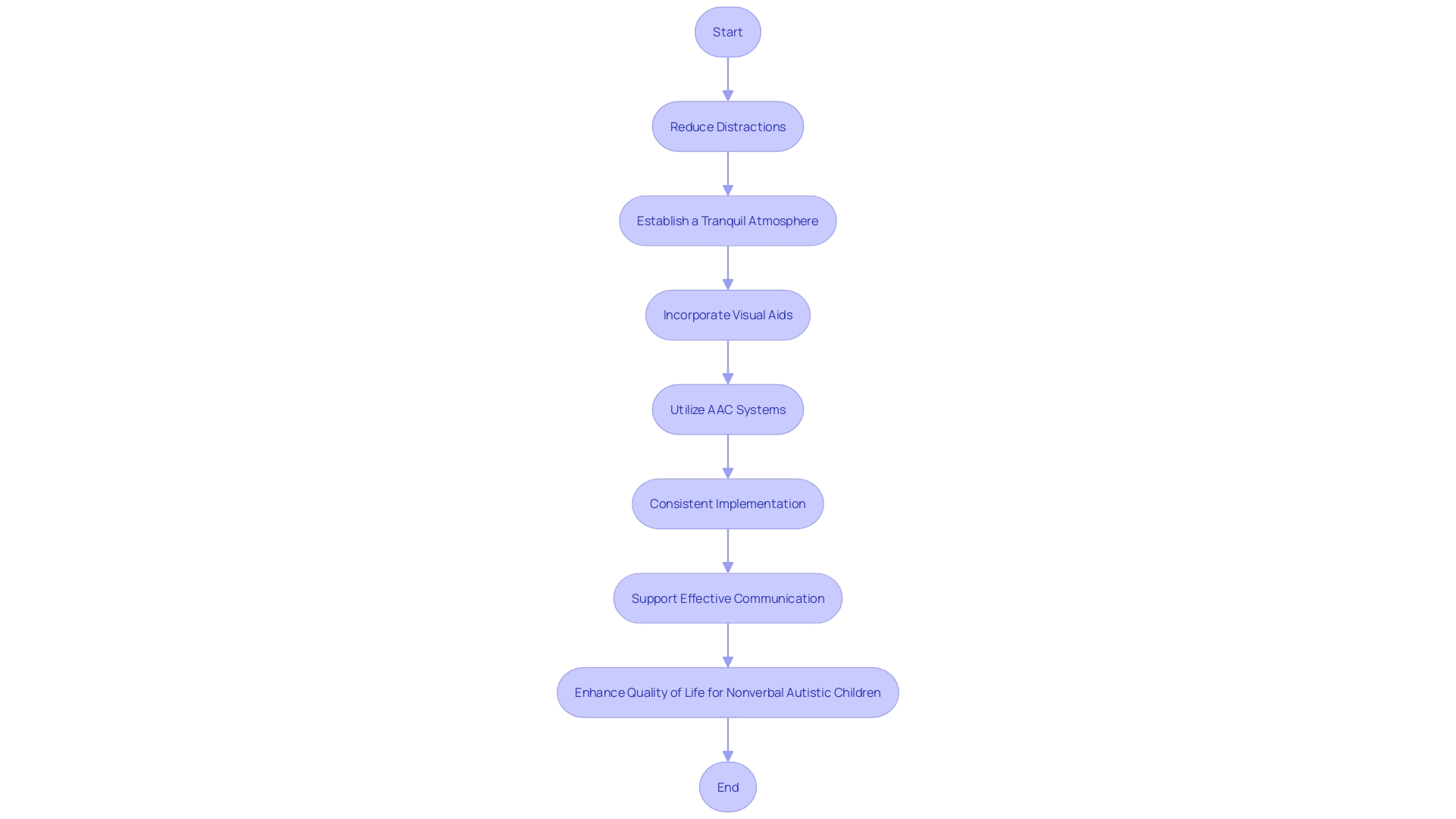
To effectively foster communication with , it is vital to . This involves streamlining their environment to reduce distractions, establishing a tranquil and well-organized atmosphere, and incorporating . Such efforts can make a world of difference in .
Real-world applications of this approach have been transformative, as seen in the case where electronic tablets and picture boards became to communicate, leading to and understanding. Ongoing research underscores the need for continued innovation and training, particularly in , which can significantly enhance the quality of life for children with developmental disabilities. By embracing these strategies and technologies, we can create a foundation that not only supports communication but also honors the individuality and capabilities of each child.
When engaging with on the autism spectrum, fostering a sense of connection is paramount. This can be achieved by involving them in that resonate with their unique interests and sensory preferences. For instance, incorporating and can significantly enhance rapport.
These activities not only facilitate trust but also pave the way for more profound communication and cooperation.
A compelling case is that of Lil, a 17-year-old transitioning from special school to a community-based program, where the uncertainty of new environments posed a significant challenge. Similarly, in a dental setting, an Augmented Reality (AR) application was designed to align with autistic individuals' ; converting tactile sensations into visual and auditory cues to reduce anxiety.
In educational settings, like the instance of the six-year-old child who was initially disengaged from a class activity, adjustments that consider their comfort with certain sensory inputs can lead to more . The child eventually engaged through an interactive storytelling approach, which allowed him to connect with the activity in a way that resonated with him uniquely.
Furthermore, emerging technologies, such as apps that track eye movement and sensory responses, offer innovative methods for and engagement. They leverage the natural affinity many autistic children have with visual and auditory stimuli.
Recent news on the introduction of more accessible toys, like LEGO's Braille bricks, highlight the importance of inclusive play. These initiatives demonstrate the value of understanding and integrating the particular interests and sensory experiences of children with autism into various aspects of their lives, from learning to play.
The goal is to ensure that every child feels valued and understood, transforming the way we connect with nonverbal autistic children by embracing their world.

Efficient support for 's communication is a continuous journey that evolves with the latest research and technological advancements. It's crucial for parents and educators to stay abreast of new findings and integrate innovative methods into their approach. Drawing from recent studies, we've learned the importance of creating a tailored to the child's unique needs, utilizing , and engaging with various communication partners like family members and educators.
An inspiring example is the story of a 10-year-old who started using an electronic tablet to communicate, marking a pivotal moment for his family. This breakthrough led to advocacy for and the implementation of picture boards to facilitate communication, demonstrating the transformative impact of technology.
Through ongoing projects, experts are developing to enhance family member involvement in communication strategies. These interventions are crafted through feedback from focus groups, ensuring they are practical and meet real-world needs.
In parallel, it is essential for caregivers to critically evaluate the plethora of information available online. Establishing a firm understanding of their child's treatments and medications, and discerning credible sources from misleading ones, is vital.
As we embrace an empathetic approach to communication, akin to understanding a partially known foreign language, we foster an environment where every attempt at communication is celebrated and reinforced, and where patience and simple, clear language are paramount.
Nonetheless, embracing new findings and approaches doesn't overshadow the fundamental principles of patience, clear language, , and following the child's lead. These core tips continue to guide communication with , ensuring that every effort to connect is acknowledged and encouraged.

Harnessing the expertise of speech-language pathologists, occupational therapists, and behavior analysts is pivotal in enhancing communication with . These professionals contribute that can be tailored to each child's unique needs. By engaging with and online communities, families can gain access to a wealth of additional resources and .
Organizations like Communication 4 ALL, established by Elizabeth Bonker, a nonspeaking advocate, are at the forefront of this endeavor. Their mission is to empower over 30 million nonspeaking individuals globally by advocating for their communication rights, fostering community alliances, and providing . The impact of technology in facilitating communication cannot be overstated, as evidenced by the life-changing experience of Josh Harris, who began to express himself using an electronic tablet.
The importance of staying informed about the latest developments in therapy and medication cannot be understated. Parents must carefully consider the benefits and potential risks of treatments, as the guidance provided by researchers and professionals is crucial in navigating the vast array of information available online.
Research continues to evolve, with projects like the NCSER grant focusing on teaching support staff optimal . Meanwhile, families seeking guidance on AAC can look forward to new interventions and professional development programs designed to improve support for nonverbal children.
Embracing , as highlighted in a survey involving autistic adults, parents, and supporters, is essential. These goals emphasize the child's strengths and interests and advocate for changes in the adults and environments that surround the child, rather than trying to alter the child's inherent nature.
In conclusion, the collective efforts of professionals, researchers, and organizations converge to create a supportive ecosystem where nonverbal autistic children can thrive, communicate, and be understood within a society that recognizes and values their unique perspectives.

In conclusion, understanding the differences between nonverbal and nonvocal autism is crucial for developing tailored communication strategies for children on the autism spectrum. Recognizing the nuances between these forms of autism empowers parents to provide the necessary support for their children.
Using nonverbal cues and gestures can significantly aid in fostering understanding and communication with nonverbal autistic children. Incorporating visual aids, such as picture boards and flashcards, offers tangible and relatable means for children to express their thoughts and needs. Additionally, utilizing music and dance as communication tools allows for emotional expression and connection without the need for words.
Communication devices and technology, such as speech-generating devices and augmented reality applications, have revolutionized communication for nonverbal children with autism. These tools empower children to engage with the world around them and bridge the gap between autistic and neurotypical individuals.
Creating a supportive environment that reduces distractions and incorporates visual aids is essential for effective communication. Building trust and rapport through interactive activities that align with the child's interests fosters meaningful connections and cooperation. Seeking professional help from speech-language pathologists, occupational therapists, and behavior analysts can provide invaluable guidance and resources.
In conclusion, by staying informed, embracing new findings, and utilizing available resources, parents and caregivers can empower nonverbal autistic children to communicate and thrive. Every effort to connect and communicate should be acknowledged and encouraged, fostering an environment that values their unique perspectives and capabilities.
What is nonverbal autism?
Nonverbal autism is a form of autism spectrum disorder where an individual has significant difficulties with spoken language. They may not speak at all or have a very limited ability to use spoken words.
How does nonvocal autism differ from nonverbal autism?
While nonverbal individuals struggle with spoken language, those with nonvocal autism may have the ability to speak but often choose not to or only exhibit limited verbal communication. They might be able to speak in some situations but not others.
What are alternative communication methods for nonvocal individuals with autism?
Alternative communication methods include typing, using picture boards, sign language, and speech-generating devices. These methods enable individuals to express themselves without relying on traditional spoken language.
Who is Elizabeth Bonker and what is Communication 4 ALL?
Elizabeth Bonker is a nonspeaking advocate who founded Communication 4 ALL. This organization champions the rights of over 30 million non-speaking individuals with autism globally by raising awareness and fostering community alliances to ensure educational opportunities.
Why is understanding nonverbal communication important in autism?
Nonverbal communication, such as gestures, facial expressions, and body language, provides alternative pathways for individuals with autism to express themselves and engage with others, especially when spoken language is difficult.
Can non-speaking autistic individuals understand language?
Yes, non-speaking autistic individuals can understand language and engage with it cognitively, as demonstrated by research showing their ability to anticipate letter sequences and express complex thoughts through alternative communication methods.
How can visual aids like flashcards help nonverbal autistic children?
Flashcards can help by providing a visual representation of words, objects, or concepts, aiding in communication and learning. They can enhance vocabulary acquisition, assist in expressing needs, and support social interaction.
What role does sign language play in communication for nonverbal autistic children?
Sign language offers a visual and gesture-based method of communication that can be easier for nonverbal autistic children to learn and use compared to spoken language, helping them to express words and ideas.
How can play and social interaction encourage communication?
Play and social interaction that align with a child's interests can create a supportive environment for communication and social engagement, using toys, games, and social stories to foster interaction and language development.
What is the significance of music and dance in communication for nonverbal autistic children?
Music and dance can be powerful tools for self-expression, emotional release, and social connection for nonverbal autistic children. These activities can enable them to communicate and engage with others without relying on speech.
How do communication devices and technology assist nonverbal children with autism?
Devices like speech-generating devices, tablets with communication apps, and AR applications can empower nonverbal children to express themselves and interact with the world, accommodating their sensory preferences and communication needs.
What can be done to create a supportive communication environment for nonverbal autistic children?
Creating a supportive environment involves reducing distractions, organizing space efficiently, and incorporating visual aids to simplify communication and understanding.
Why is building trust and rapport important when interacting with nonverbal autistic children?
Building trust and rapport through interactive activities tailored to the child's interests and sensory preferences can lead to more meaningful communication and cooperation, enhancing the child's engagement and comfort.
What practical tips are available for parents and caregivers of nonverbal autistic children?
Tips include staying updated on research and technology, using augmentative and alternative communication systems, creating a supportive environment, and engaging with various communication partners. Patience, clear language, visual supports, and following the child's lead are fundamental.
How can professional help and resources benefit nonverbal children with autism?
Professionals like speech-language pathologists can offer tailored strategies and techniques to enhance communication. Organizations and online communities provide resources, advocacy, and support for nonverbal individuals and their families.