

Introduction
Autism Spectrum Disorder (ASD) poses unique challenges in communication, particularly in verbal expression. For individuals on the spectrum, non-verbal cues become essential in conveying thoughts and emotions. Recognizing the significance of non-verbal communication in ASD, recent research and educational interventions have focused on empowering individuals and supporting alternative avenues of expression.
This article explores the role of gestures in communication for individuals with ASD, the types of prompts used in Applied Behavior Analysis (ABA) therapy, and the importance of fading prompts to promote independence. Additionally, case studies and research highlight the profound impact of gestural prompts in enhancing communication skills and fostering inclusion for individuals on the autism spectrum. By understanding and valuing non-verbal communication, we can create a more equitable and accessible environment for individuals with ASD.
Understanding Autism Spectrum Disorder (ASD) and Communication Challenges
Autism Spectrum Disorder (ASD) encompasses a variety of challenges in communication and social interaction. Verbal communication, often taken for granted, can pose significant hurdles for individuals on the spectrum, creating a reliance on to express themselves. Recognizing gestures, facial expressions, and body language becomes a pivotal skill in fostering connections for those with ASD.
Notably, a study in the Journal of Autism and Developmental Disorders illuminated how teens with autism display distinct patterns in learning and recognizing human faces, which may influence their non-verbal communication abilities. This research echoes the importance of understanding and supporting non-verbal communication in ASD as a key component for enhancing interaction and comprehension.
In the pursuit of improving outcomes for individuals with ASD, recent educational interventions have aimed at empowering educators and paraeducators to effectively support children who use Augmentative and Alternative Communication (AAC) systems. Such systems are instrumental in providing alternative avenues for expression and interaction. The dedication to this cause has spanned decades and continues to evolve, with current research focusing on training school-based Speech-Language Pathologists (SLPs) to facilitate family members in implementing AAC strategies.
Moreover, the development of literacy in non-speaking autistic individuals is an area of ongoing investigation. Researchers, including Professor Vikram Jaswal from the University of Virginia, have devised innovative methods to understand how these individuals process written language. By adapting a technique akin to the game Whac-a-Mole, the team was able to deduce that literate, non-speaking autistic individuals can anticipate the sequence of letters in a sentence they have previously heard, showcasing their cognitive engagement with language.
Understanding the nuances of non-verbal communication in ASD is not only crucial for personal development but also has implications for mental health care. Research indicates that autistic individuals often endure more mental health conditions and face greater obstacles in patient-caregiver communication. A study aims to identify these barriers and recommend practices to ensure that autistic patients can convey their needs effectively, thus receiving appropriate care at the right time.
The intricate link between non-verbal communication and the overall well-being of those with ASD underscores the importance of continuous research, tailored educational programs, and inclusive health care practices that prioritize the unique communication needs of the autistic community.
The Role of Gestures in Communication for Individuals with ASD
Understanding the intricacies of communication in autism spectrum disorder (ASD) extends beyond verbal expression to the realm of , where gestures play a significant role. These gestures encompass a variety of movements and expressions, such as pointing, waving, and nodding, which can be critical in conveying messages for those with ASD. Research highlights the importance of iconic gestures that accompany speech; these gestures visually represent concepts like size, shape, and motion, thereby reinforcing the spoken message.
In individuals with ASD, the integration of such gestures with speech can enhance clarity—even in noisy environments—by providing additional semantic information. The coordination of these gestures with speech requires a synchrony of various physiological systems, indicating a complex underlying process. Acknowledging the diverse ways ASD manifests, it’s essential to recognize the value of non-verbal communication in fostering more accessible and effective interactions.
Case studies and personal accounts reveal the profound impact of [understanding non-verbal cues](https://rori.care/post/10-effective-functional-communication-training-aba-examples-you-can-use-today), such as a non-speaking autistic teenager who used gestures to express pain when verbal communication was not an option. This underscores the necessity for careful consideration and continued research into interventions that respect and cater to the communication needs of those with ASD.
Types of Prompts in ABA Therapy
is an established and research-backed treatment methodology for individuals on the autism spectrum. ABA utilizes a variety of prompts to foster skill acquisition, a method particularly effective in enhancing communication abilities. The art of prompting within ABA involves strategically employing various categories such as verbal, visual, gestural, and modeling prompts.
The selection and application of each prompt type are meticulously tailored to meet the unique requirements and skill levels of each individual, ensuring a personalized approach to therapy. The effectiveness of ABA in improving communication skills is underscored by a rich body of research, which suggests that carefully designed prompts can significantly aid in the learning process for those with ASD, thereby enhancing their ability to express themselves and interact with the world around them.
Gestural Prompts: Definition and Examples
Utilizing within therapy sessions offers a nonverbal avenue for therapists to initiate communication, demonstrate desired behaviors, or prompt imitation in individuals with Autism Spectrum Disorder (ASD). This technique, hinging on visual signals such as pointing or miming actions, speaks to the unique sensitivities and strengths of this community. For instance, while verbal prompts may not always resonate, a gestural cue can provide a clear and direct method to guide an individual towards the intended response.
This approach aligns with broader efforts in promoting fair and supportive participation for children with disabilities, ensuring they are equipped with the necessary tools to navigate their environments effectively. Such adaptive strategies are essential in the quest for equitable opportunities and mental well-being, as emphasized by the respected insights of Dr. David (Dan) R. Offord. As we strive to recognize and valorize the assets of all children, including those with ASD, gestural prompts stand as an example of tailoring interventions to meet diverse needs while fostering inclusion and reducing stress within their daily lives.
How Gestural Prompts Support Learning and Communication
Gestural prompts are a powerful tool in enhancing learning and communication for individuals on the autism spectrum. By offering visual cues, these prompts assist in clarifying expectations and guiding behavior, which is particularly beneficial given the heightened visual and auditory sensitivities in the autistic community. For example, an Augmented Reality (AR) application designed to translate tactile sensations into visual and auditory information exemplifies the importance of visual supports in managing sensory challenges during a dental visit, highlighting the potential of gestural prompts in various settings.
Iconic gestures, which visually represent concrete concepts like shape or size, enrich communication by integrating with linguistic information. This integration occurs at multiple levels, from semantics to pragmatics, and is effective in both clear and noisy environments. It is well-documented that speakers use these gestures to supplement speech, providing a rich context that supports comprehension and social interaction.
Recent research by Professor Vikram Jaswal from the University of Virginia explored how nonspeaking autistic individuals respond to written language. This study, employing a Whac-a-Mole-like method on a tablet, revealed that nonspeaking autistic participants could indeed anticipate the sequence of letters forming sentences they had previously heard, underscoring the relevance of visual processing in the autistic population.
Furthermore, the importance of social participation for children with disabilities, including those with autism, cannot be overstated. It serves as a critical determinant of mental health and equity, as noted by child psychiatrist Dr. David (Dan) R. Offord. Thus, recognizing the of these children is vital for their inclusion in social domains.
In the context of education, gestural prompts can significantly aid children who use Augmentative and Alternative Communication (AAC) systems. Research into AAC suggests ongoing efforts to understand the best ways to support child communication through various communication partners, including family members and educators. The development of new training interventions for speech-language pathologists reflects the commitment to enhancing communication outcomes for children with developmental disabilities, emphasizing the role of gestural prompts in educational settings.
Overall, incorporating gestural prompts into therapeutic and educational strategies offers a means to support non-verbal communication, promote social learning, and facilitate meaningful interactions for individuals with autism, contributing to a more equitable and accessible environment for all.

Using Gestural Prompts in ABA Therapy: A Step-by-Step Guide
To support individuals with autism in enhancing their communication, a tailored approach to is essential. Begin by evaluating their present communication abilities and identifying specific areas for improvement. Select gestures that not only align with their communication needs but also resonate with their personal interests and objectives.
Introduce the chosen gestures through clear demonstrations, showing the individual how to perform them effectively. Employ these gestures as cues to aid their communication, encouraging their use across various situations and reinforcing their attempts with positive feedback. As proficiency grows, gradually reduce the guidance provided, shifting from physical prompts to verbal or visual cues.
To ensure these skills are not limited to therapy sessions, practice in diverse settings is crucial, promoting the generalization of gesture use in everyday interactions. This methodical approach is supported by research indicating that gestures play an integral role in enhancing semantic, syntactic, prosodic, discourse, and pragmatic aspects of communication. Furthermore, it addresses misconceptions about the communicative abilities of individuals with autism, emphasizing that speech is not the sole expression of language, and with the right support, nonverbal methods can effectively convey thoughts.
The rise in autism awareness and varied manifestations of the condition necessitate tailored interventions, recognizing the unique abilities and challenges faced by each individual. As we consider the broader implications of engagement and participation for children with disabilities, ensuring equitable opportunities and reducing stressors is paramount for their mental health and social inclusion.

Prompt Hierarchy: From Gestural to Independent Performance
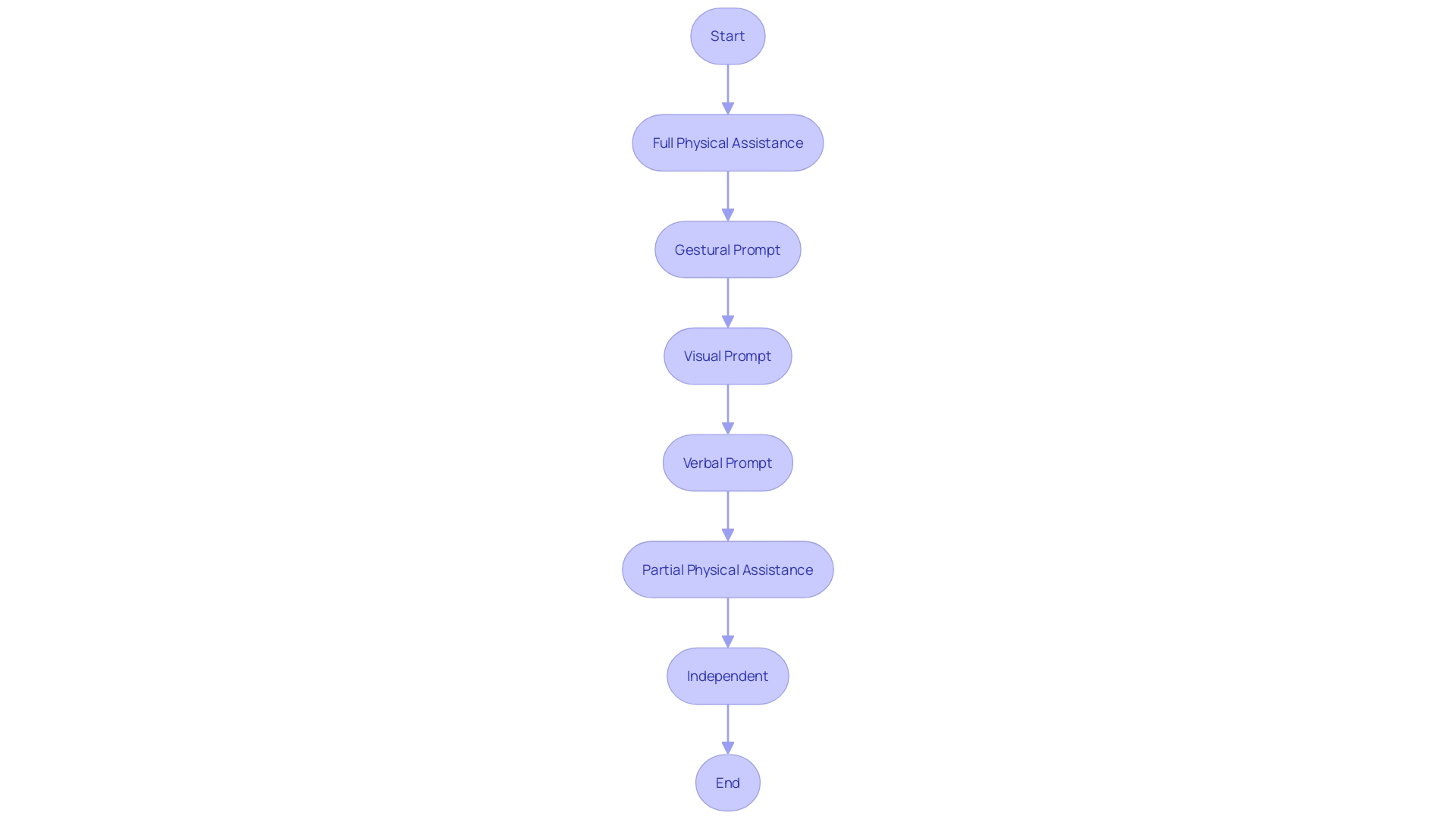
In Applied Behavior Analysis (ABA) therapy, a carefully structured approach is taken to ensure that individuals learn and master new skills. This process often incorporates a that decrease in intrusiveness over time. Initially, therapists might need to provide substantial assistance, such as hands-on support or explicit verbal instructions.
However, as the individual progresses, these prompts are systematically reduced to more subtle cues like simple gestures. This methodical reduction of assistance is not just about teaching a specific skill; it’s about nurturing the individual’s ability to perform tasks independently.
Kara, a pediatric occupational therapist from Florida, highlights the transformative impact of fostering independence in children with autism. By integrating a similar philosophy of gradually promoting self-sufficiency, she has observed remarkable advancements in the children she works with. Kara’s experience underscores the importance of independence therapy, reflecting a broader shift towards empowering individuals with autism to navigate tasks autonomously.
Recent updates to ABA therapy guidelines by the Council of Autism Service Providers emphasize the necessity of high-quality, well-implemented treatment strategies. These guidelines reinforce the significance of using evidence-based practices to instill independence in individuals with autism. As we learn from practitioners like Kara and organizations dedicated to autism support, the journey towards independence is both possible and profoundly rewarding for those on the autism spectrum.
Fading Prompts to Promote Independence
Teaching independent skills to individuals with Autism Spectrum Disorder (ASD) often involves a strategic process known as fading prompts, a staple within Applied Behavior Analysis (ABA) therapy. The essence of prompt fading lies in its careful, step-by-step reduction, moving from more direct physical guidance to less intrusive verbal or visual cues. It’s a delicate balance where the therapist must keenly observe the individual’s response and adapt the approach as needed.
Fading gestural prompts is particularly nuanced. It begins with minimizing overt physical gestures and transitions towards subtle cues that can still guide but also encourage autonomous responses. The ultimate aim is for the individual to perform tasks without any prompts, thereby achieving independence in their communication abilities.
This therapeutic transition is backed by a wealth of evidence-based procedures, including those from , which help in understanding and addressing behaviors that may interfere with an individual’s success both at home and educational environments. The introduction of innovative methods like the Interview Informed Synthesized Functional Analysis (IISCA) has further enriched the landscape of behavioral assessment, allowing for a more nuanced understanding of problem behaviors and their functions, which in turn informs the fading process.
It is crucial to note that the need for such tailored interventions has become even more apparent in the face of challenges such as those posed by the pandemic, which exacerbated behavioral problems in more than one-third of individuals with autism. Moreover, the journey towards adulthood for those with autism brings unique mental health challenges, often compounded by societal pressures and cultural norms that may not be as understanding of neurodiversity. Autistic individuals, particularly in non-Western societies that stress conformity, may experience an additional layer of mental strain, highlighting the importance of adaptable and sensitive therapeutic approaches like prompt fading within ABA therapy.

Case Studies and Research on Gestural Prompts in ASD
Research has illuminated the profound impact of integrating gestural prompts with Applied Behavior Analysis (ABA) therapy for individuals on the autism spectrum. Iconic gestures, which represent concrete aspects such as shape and motion, are merged with speech to enhance the semantic, syntactic, and pragmatic aspects of communication. This integration has been shown to significantly as well as social communication in individuals with Autism Spectrum Disorder (ASD).
A recent study conducted by Vikram Jaswal, Professor of Psychology at the University of Virginia, underscores the importance of understanding non-verbal communication cues in promoting literacy among non-speaking autistic individuals. The study found that participants could anticipate the next letter in a sentence they had previously heard, demonstrating the capability for language comprehension beyond speech.
Furthermore, statistics reveal that equitable participation in social domains is critical for the mental health and well-being of children and youth with disabilities. The inclusion of gestural prompts in therapeutic interventions acknowledges the unique needs and strengths of autistic individuals, striving to make the ‘race’ fair, as emphasized by the late child psychiatrist Dr. David (Dan) R. Offord.
This approach challenges the outdated conflation of speech with language capacity, recognizing that speech is only one avenue for language expression. By valuing the diverse communication methods of autistic individuals, including gestural cues, we can foster a more inclusive and respectful environment, enhancing their potential for meaningful interaction and learning.

Best Practices for Implementing Gestural Prompts
Optimizing gestural prompts as a therapeutic tool for individuals with Autism Spectrum Disorder (ASD) necessitates a tailored approach that respects each person’s unique sensory experiences and communication needs. The effectiveness of such prompts hinges on crafting them with precision and consistency, ensuring they resonate with the individual’s comprehension abilities. Reinforcement and feedback play pivotal roles in reinforcing the appropriate use of gestures, thereby encouraging autonomy in communication.
Furthermore, an interdisciplinary collaboration enriches the therapeutic landscape, bringing together insights from speech therapy, occupational therapy, and other relevant fields to create a comprehensive communication strategy. This integrative method not only acknowledges the individual’s sensory responses—such as the varying reactions to tactile stimuli noted in dental care scenarios—but also leverages , like the visual and auditory systems, which are often more finely attuned in the autistic community.
Monitoring progress is a dynamic process that necessitates ongoing adjustment to align with the individual’s evolving skills and challenges. Inclusion of parents and caregivers into the therapeutic journey is crucial, as it extends the benefits of therapy beyond clinical settings into everyday life, promoting a seamless transition of skills.
By embracing these best practices, we can foster an environment where children and youth with disabilities experience equitable participation in all life domains, as emphasized by Dr. David (Dan) R. Offord. The ultimate goal is to ensure that every child, including those at high risk of social exclusion, can enjoy meaningful engagement in their community, thereby nurturing their mental health and overall well-being.

Conclusion
In conclusion, understanding and valuing non-verbal communication in Autism Spectrum Disorder (ASD) is crucial for enhancing communication skills and fostering inclusion. Gestures play a significant role in communication for individuals with ASD, providing an alternative avenue for expression and enhancing clarity. Research has shown that integrating iconic gestures with speech enriches communication by providing additional semantic information.
ABA therapy utilizes various prompts, including gestural prompts, to improve communication skills in individuals with ASD. Personalized application of prompts tailored to individual needs is key to the effectiveness of ABA therapy. Gestural prompts assist in clarifying expectations and guiding behavior, particularly benefiting individuals with heightened sensory sensitivities.
Integrating gestural prompts into therapy and education promotes non-verbal communication and meaningful interactions, creating a more accessible environment.
Fading prompts within ABA therapy is essential for promoting independence. Gradually reducing assistance levels empowers individuals with ASD to perform tasks autonomously, nurturing their development of independent skills. Implementing tailored gestural prompts considers sensory experiences and communication needs, and collaboration with parents and caregivers extends therapeutic benefits beyond clinical settings.
Recognizing and valuing diverse communication methods, including gestural cues, fosters an inclusive environment for individuals with ASD. By empowering individuals to express themselves effectively, meaningful interactions are promoted, contributing to their mental health and overall well-being.
In conclusion, understanding and leveraging the power of non-verbal communication creates an equitable and accessible environment for individuals with ASD, empowering them to thrive and succeed.
Frequently Asked Questions
What is Autism Spectrum Disorder (ASD)?
Autism Spectrum Disorder (ASD) is a developmental disorder characterized by challenges with communication and social interaction. Individuals on the spectrum often experience difficulties with verbal communication and may rely on non-verbal cues to express themselves.
How do individuals with ASD communicate non-verbally?
Non-verbal communication for individuals with ASD includes recognizing and using gestures, facial expressions, and body language. These non-verbal cues are pivotal for making connections and expressing themselves when verbal communication is challenging.
What did a study in the Journal of Autism and Developmental Disorders reveal about teens with autism?
The study found that teens with autism exhibit distinct patterns in learning and recognizing human faces, which can affect their non-verbal communication skills. This research highlights the significance of supporting non-verbal communication in ASD.
What are Augmentative and Alternative Communication (AAC) systems?
AAC systems provide alternative ways for individuals with ASD to express themselves and interact with others. These systems can include technology, symbols, and other tools to facilitate communication for those who may have trouble with traditional speech.
How does research contribute to the understanding of literacy in non-speaking autistic individuals?
Researchers, like Professor Vikram Jaswal from the University of Virginia, have developed methods to study how literate, non-speaking autistic individuals process written language. One such method showed that participants could predict the sequence of letters in a sentence, demonstrating cognitive engagement with language.
Why is understanding non-verbal communication in ASD critical for mental health care?
Research indicates that individuals with ASD often face additional mental health conditions and communication barriers in health care settings. Understanding and improving non-verbal communication can help ensure that autistic patients can effectively convey their needs and receive proper care.
What role do gestures play in communication for individuals with ASD?
Gestures such as pointing, waving, and nodding are essential in conveying messages for those with ASD. Iconic gestures that visually represent concepts can enhance speech by providing additional information, especially in noisy environments.
What is Applied Behavior Analysis (ABA) therapy and how does it use prompts?
ABA therapy is a treatment methodology for individuals with ASD that uses different types of prompts (verbal, visual, gestural, and modeling) to assist in skill acquisition, particularly in communication.
How do gestural prompts support learning and communication in ASD?
Gestural prompts offer visual cues that help clarify expectations and guide behavior. These prompts can be particularly beneficial for individuals with heightened visual and auditory sensitivities, supporting their comprehension and social interaction.
What is the importance of fading prompts in ABA therapy?
Fading prompts involves gradually reducing the level of assistance provided, from more direct guidance to subtler cues. This process encourages individuals with ASD to perform tasks independently and develop their communication abilities.
Can non-verbal communication methods be as effective as speech for individuals with ASD?
Yes, non-verbal communication methods, such as gestural prompts, can effectively convey thoughts and enhance expressive and receptive language skills for those with ASD, emphasizing that speech is not the only form of language expression.
What are best practices for implementing gestural prompts with individuals with ASD?
Best practices include tailoring prompts to the individual’s sensory experiences and communication needs, providing reinforcement and feedback, ensuring interdisciplinary collaboration, and involving parents and caregivers in the therapeutic process to extend the benefits into daily life.