In the realm of Applied Behavior Analysis (ABA) therapy, understanding the concept of abolishing operations is crucial for effectively modifying behavior. Abolishing operations refer to the decrease in the attractiveness of a behavior by reducing its reinforcing value. This article explores the definition and function of abolishing operations, the impact they have on behavior, strategies for utilizing them in ABA therapy, case studies and research on their effectiveness, and practical applications in the field.
By delving into these aspects, parents and caregivers can gain valuable insights and expert advice to empower them in their therapeutic journey.
are a natural response when an accustomed behavior no longer yields previously expected rewards. Imagine a vending machine that suddenly stops dispensing snacks despite accepting your money. Your initial reaction might be to press the button more frequently or harder, illustrating an extinction burst—increased attempts to elicit the familiar outcome.
In therapy, when a child's no longer receives the usual reinforcement, this might trigger an intensified form of the behavior, much like pressing the vending machine button. However, this phenomenon is temporary and is a critical phase towards . By , such as altering access to specific reinforcers or changing the setting itself, therapists can guide children past this challenging stage.
Ultimately, this leads to the adoption of new, , marking progress in their .
and stand at opposite ends of the behavioral spectrum in applied behavior analysis. decrease the attractiveness of a behavior by reducing its reinforcing value, which contrasts with that increase a behavior's desirability by enhancing its reinforcement. This understanding is pivotal when constructing , as it influences the effectiveness of the strategies employed.
For instance, if a child's disruptive behavior is no longer reinforced, may lead to a temporary rise in this negative behavior, known as an , before it gradually diminishes.
(CBT) encapsulates the interdependence of thoughts, feelings, and behaviors, endorsing that altering negative thought patterns can lead to significant mental health improvements. The practical and goal-directed nature of CBT aligns itself with the concepts of establishing and , as both approaches aim to modify behavior through .
A real-world application of these principles is evident in workplace Behavior Change Programs, which aim to transition from unwanted behaviors to positive actions to enhance wellbeing and achieve goals. For example, Johnson & Johnson's comprehensive employee wellbeing program, initiated in 2013, is grounded in the same fundamental understanding of modifying behavior for better outcomes.
The importance of accurately identifying and implementing these operations cannot be overstated, as evidenced by the extensive experience of a New York state-licensed and Board-Certified Behavior Analyst, who emphasizes the need for and technology solutions that adhere to best practices.
As intervention participation is paramount to the success of any behavioral program, it's crucial to consider various factors such as the number of intervention hours and the length of time between enrollment and intervention outcome. These considerations help define 'engaged participation,' which is essential for the effective application of both establishing and abolishing operations within therapeutic contexts.
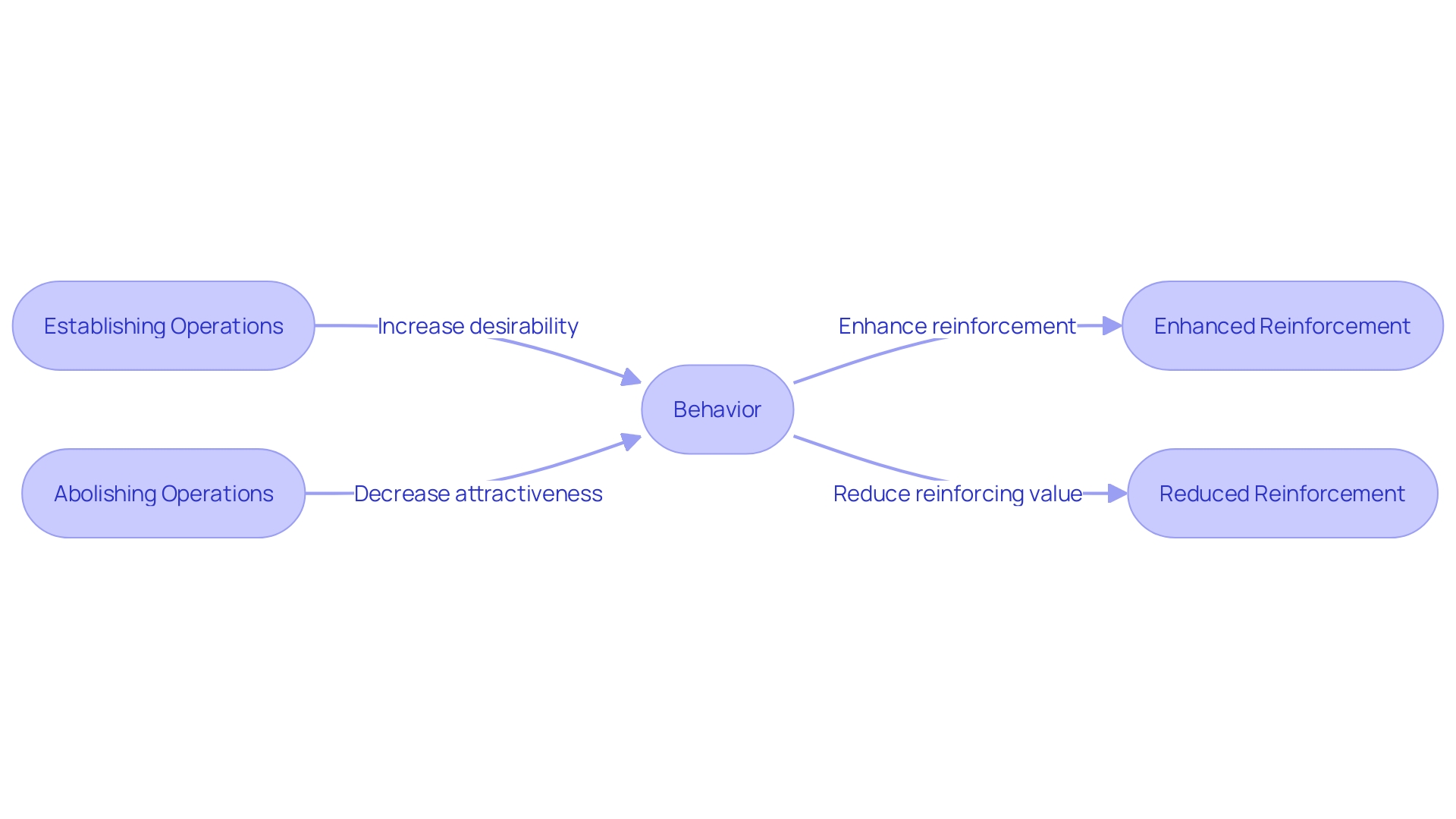
In the realm of , abolishing operations play a pivotal role in influencing . These operations can present in different forms, affecting the efficacy of . Here are some of the ways they can manifest:
Understanding these concepts is essential for therapists and care providers to effectively. With advancements in technology and the integration of innovative solutions, providers can ensure coordinated care that acknowledges each individual's unique . This approach not only streamlines processes but also , as seen in the collaboration between Aetna Better Health of Kentucky and technology partners to train providers in addressing the diverse needs of each member.
Research on preference for interventions, particularly through applied evaluations of concurrent-chains arrangements, reinforces the significance of understanding abolishing operations. These studies highlight the necessity of a behavior-analytic procedure that produces a noticeable change in behavior for clinical populations, underscoring the importance of choosing appropriate reinforcers based on current motivational states.
As we strive for a better understanding of human behavior and motivation, it's crucial to incorporate these insights into therapeutic practices. They not only contribute to the evolution of ABA therapy but also to the broader field of behavioral healthcare, which continues to destigmatize and normalize seeking assistance for mental health challenges.
Grasping the dynamics of behavior change is a pivotal aspect of developing successful interventions in . Specifically, the concept of an is vital to comprehend. s refer to an increase in the frequency, duration, or intensity of a behavior once positively reinforced, which no longer receives such reinforcement.
This intensification is not a sign of failure; rather, it indicates that the intervention is taking effect. Clinicians and parents should view an as a natural part of the and maintain their course without wavering.
A recent evaluation of studies employing a concurrent-chains arrangement to assess intervention preference highlights the importance of . This research, spanning from January 2018 to June 2023, underscores the significance of interventions designed to elicit noticeable change in behavior deemed socially important. It also establishes that effective interventions require a robust and .
The complex nature of behavior change is further underscored by a Board-Certified Behavior Analyst with over a decade of clinical experience. Her expertise in developing technology solutions that align with best practices in coordinated care emphasizes the need for interventions that are not only based on principles but also proven effective in practice.
Moreover, experts in behavior change have organized various interventions into helpful frameworks that practitioners can utilize. Although these frameworks offer descriptive value, they do not necessarily guarantee the efficacy of the interventions. This underlines the need for evidence-based strategies and the importance of understanding the mechanisms underlying behavior change, rather than relying solely on intuition or principles.
Ultimately, recognizing the and understanding its implications within the broader context of behavior change science is essential. Clinicians and parents must be prepared for this inevitable phase, armed with the knowledge that persistence through such challenging periods is crucial for achieving long-term success in ABA therapy.
In Applied Behavior Analysis (ABA) therapy, addressing the root causes of challenging behaviors is essential. Therapists use several strategies to modify conditions that may encourage undesirable behaviors, commonly known as abolishing operations. For instance, is a technique that equips individuals with alternative communication methods.
This could include using a or augmentative and alternative communication (AAC) devices, enabling them to articulate their needs effectively and thus reducing the impulse to engage in problem behaviors.
are another valuable tool. These assessments determine what items or activities are most preferred by an individual and can therefore be used as powerful reinforcers. By offering these preferred choices only in response to appropriate behaviors, the motivation to engage in challenging behaviors can be significantly lessened.
A strategy called involves slowly diminishing either the availability or appeal of a reinforcer, which helps individuals decrease their dependence on certain reinforcers. This approach requires a systematic reduction in the frequency or intensity of the reinforcer to support the individual in adjusting to changes and minimize the emergence of challenging behaviors.
Lastly, is a critical component of ABA therapy, where therapists identify the specific environmental factors that contribute to the maintenance of challenging behaviors. By understanding the function that these behaviors serve, therapists can create targeted interventions that tackle the underlying motivations, thus effectively decreasing their occurrence.
These are enhanced by a deeper understanding of disability through the lens of . Such perspectives consider disability not as a deficiency but as a part of human diversity. This shift in thinking supports the need for societal changes rather than expecting individuals to adjust to a world not designed for them.
With a decade of clinical experience, experts in the field emphasize the need for best practice approaches that are not just high quality and coordinated but also considerate of the diverse needs of individuals with disabilities.
Insights from recent studies highlight the in managing the behavior of individuals with Autism Spectrum Disorder (ASD). These interventions are designed to reduce challenging behaviors and encourage positive developments. In particular, the is backed by pivotal data from The Center for Discovery, where machine learning and artificial intelligence have been utilized to interpret complex datasets.
Dr. Theresa Hamlin, a co-author of the study, expresses excitement about the potential to predict significant behavior, thus enabling proactive measures to mitigate it, marking a considerable advancement in the field.
Further emphasizing the importance of , research by Professors Kenkichi Takase and Eiichi Nojiri builds upon Donald Olding Hebb's theories, deepening our understanding of ASD. Their work examines mental functionalities and their role in ASD, shedding light on the intricate neural connections.
The concept of 'inertia', as described by the Autistic community, also plays a role in understanding behavior. Academic explorations into 'inertial rest' and 'inertial motion' reveal how Autistic individuals may experience difficulty initiating tasks, despite motivation, pointing to an underlying complexity within ASD.
Additionally, the Kevin and Avonte Program, named after two autistic teens who tragically wandered away from safety, focuses on . This initiative is part of a to safeguard individuals with developmental disabilities, providing grants to enhance public awareness, education, and emergency protocols.
These developments in the field are supported by a strong advocacy for sustained and increased funding for autism research and services, as articulated in the Autism CARES Act. The Act's reauthorization is a critical step towards continuing and expanding support for the entire autism community, particularly those facing severe challenges.
Amidst these advances, it is crucial to recognize the diverse experiences of Autistic individuals, including the variability of their skills and the influence of motivation and anxiety on their abilities. Such insights are invaluable for researchers and practitioners alike, who strive to tailor interventions that resonate with the nuanced needs of those with ASD.
In conclusion, the collective efforts of researchers, clinicians, advocates, and policymakers are converging to create a more inclusive and supportive environment for individuals with ASD. By integrating these and insights, there is a promising path forward in the journey towards effective and improved outcomes for the autism community.
Abolishing operations in serve as a critical component for managing and transforming in individuals with ASD. These operations, when adeptly applied, can diminish undesirable actions while fostering the establishment of suitable behaviors. It's vital for therapists and parents to comprehend that strategies must be individualized, as each person with ASD presents a distinctive set of needs and preferences.
The nuanced approach to is underscored by new guidelines released by the Council of Autism Service Providers, which emphasize the importance of . Furthermore, the evolving landscape of autism treatment acknowledges the complexity and diversity within the spectrum. For instance, a with extensive experience highlights the significance of in enhancing coordinated care and ensuring best practices across various treatment settings.
The practicality of these operations is reflected in real-world cases, such as the use of in treating OCD, which parallels ABA's precision in targeting specific behaviors. This methodical approach is also seen in the experiences of children undergoing , where the goal is to adapt their responses to their environment, aiming for a harmonious integration without compromising their mental health.
In essence, the judicious application of abolishing operations, guided by professional expertise and the latest industry standards, plays a fundamental role in the effective implementation of . Collaborating with the child's therapy team, including seasoned professionals who can navigate the intricacies of care management, is key to the success of these interventions.
In conclusion, understanding and effectively utilizing abolishing operations is crucial in ABA therapy. These operations decrease the attractiveness of a behavior by reducing its reinforcing value. By strategically managing the environment, therapists can guide children through extinction bursts, leading to the adoption of more desirable behaviors.
Recognizing extinction bursts as a natural part of behavior modification is essential for long-term success in ABA therapy. Evidence-based strategies, such as Functional Communication Training and preference assessments, help address challenging behaviors and modify conditions that encourage undesirable actions.
Insights from case studies and research highlight the transformative power of abolishing operations in managing behavior in individuals with ASD. By integrating evidence-based practices and insights, there is a promising path forward in effective behavior management and improved outcomes for the autism community.
In summary, the judicious application of abolishing operations, guided by professional expertise and industry standards, plays a fundamental role in the effective implementation of ABA therapy. Collaboration with a child's therapy team is key to success.
What is an extinction burst in ABA therapy?
An extinction burst is an initial increase in the frequency, duration, or intensity of a previously reinforced behavior that no longer receives reinforcement. This is a natural response and a critical phase in modifying behavior.
How are extinction bursts related to abolishing operations?
Abolishing operations decrease the attractiveness and reinforcing value of a behavior, often leading to an extinction burst where the behavior temporarily intensifies before it gradually diminishes.
What are establishing operations in ABA therapy?
Establishing operations are the opposite of abolishing operations; they increase a behavior's desirability by enhancing its reinforcement, making the behavior more attractive to perform.
Can you give examples of abolishing operations?
Yes, examples include satiation (overexposure to a reinforcer), deprivation (lack of access to a reinforcer), and increased response effort (the effort required to perform a behavior outweighs the benefit).
What is Functional Communication Training (FCT) in ABA therapy?
FCT is a strategy used in ABA therapy to provide individuals with alternative methods of communication, such as picture exchange systems or AAC devices, to help them express their needs and reduce problem behaviors.
What is the role of preference assessments in ABA therapy?
Preference assessments determine the most preferred items or activities for an individual, which can be used as powerful reinforcers to encourage appropriate behaviors and reduce challenging ones.
How does gradual fading help in ABA therapy?
Gradual fading involves slowly diminishing the availability or appeal of a reinforcer to help individuals decrease dependence on certain reinforcers and minimize the emergence of challenging behaviors.
What is functional analysis in the context of ABA therapy?
Functional analysis is a process where therapists identify the environmental factors contributing to the maintenance of challenging behaviors by understanding the function these behaviors serve, allowing for the creation of targeted interventions.
How is technology being used to enhance ABA therapy?
Technology such as machine learning and artificial intelligence is being used to interpret complex datasets and predict significant behaviors, enabling proactive measures to manage and transform challenging behaviors.
What is the importance of the Autism CARES Act?
The Autism CARES Act is vital for continuing and expanding support for the entire autism community, especially for individuals facing severe challenges, by providing sustained and increased funding for autism research and services.
How are abolishing operations applied in real-world ABA therapy?
Abolishing operations are applied in real-world ABA therapy by utilizing evidence-based strategies, such as Functional Communication Training and preference assessments, to manage and transform challenging behaviors while encouraging positive developments in individuals with ASD.