Visual Basic (VB) has had a significant impact on the world of software development since its emergence in the early 1990s. With its simplicity and robust features, VB quickly gained popularity among developers, serving as a gateway into the world of programming. Over the years, VB's user-friendly design has played a vital role in education and training, attracting both self-directed learners and those pursuing formal post-secondary education.
As the technology landscape continues to evolve, so does the toolkit of the developer, with languages like VBScript being phased out in favor of more versatile options. Legacy systems written in older versions of VB are also being migrated to ensure long-term compatibility. Despite these changes, VB remains a staple in the software development realm, with applications in finance, healthcare, education, and even Microsoft Office automation.
The trajectory of Visual Basic showcases its influence on individual career paths and the broader software development landscape.
Visual Basic (VB) emerged in the early 1990s as an accessible language that enabled developers to build Windows-based applications with relative ease. When Microsoft released in 1991, it wasn't just another programming language; it was a gateway for many into the world of software development. VB's simplicity and robust features resonated with a wide user base, allowing it to rapidly gain a foothold in the development community.
In the years since its inception, Visual Basic's user-friendly design has played a significant role in education and training. A considerable proportion of developers today report using online resources to learn coding, reflecting a shift towards self-directed education in the digital age. Yet, despite the popularity of online learning, a substantial number of developers still pursue formal post-secondary education, with a majority holding some level of college or university degree.
The demographics of the developer community are also changing. While the 25-34 age group remains the largest segment, there's been a notable increase in the proportion of developers aged 35 and up. In just one year, this age bracket grew from 35% to 39%, underscoring the evolving profile of the developer workforce.
As the technology landscape continues to shift, so too does the toolkit of the developer. VBScript, for instance, a scripting language introduced by Microsoft in 1996, is being phased out in favor of more versatile and powerful languages like JavaScript and PowerShell. This evolution reflects the industry's drive towards languages that can meet the demands of modern web development and automation tasks.
Moreover, legacy systems written in older versions of VB, like VB6, are being migrated to more current platforms such as VB.NET to ensure long-term viability and compatibility. This was exemplified by An Post, one of Ireland's largest organizations, which undertook a significant project to migrate 194,000 lines of VB6 code to the .NET environment.
As we consider the trajectory of Visual Basic and its iterations, it becomes clear that this language has not only contributed to individual career paths but has also influenced the broader software development landscape.
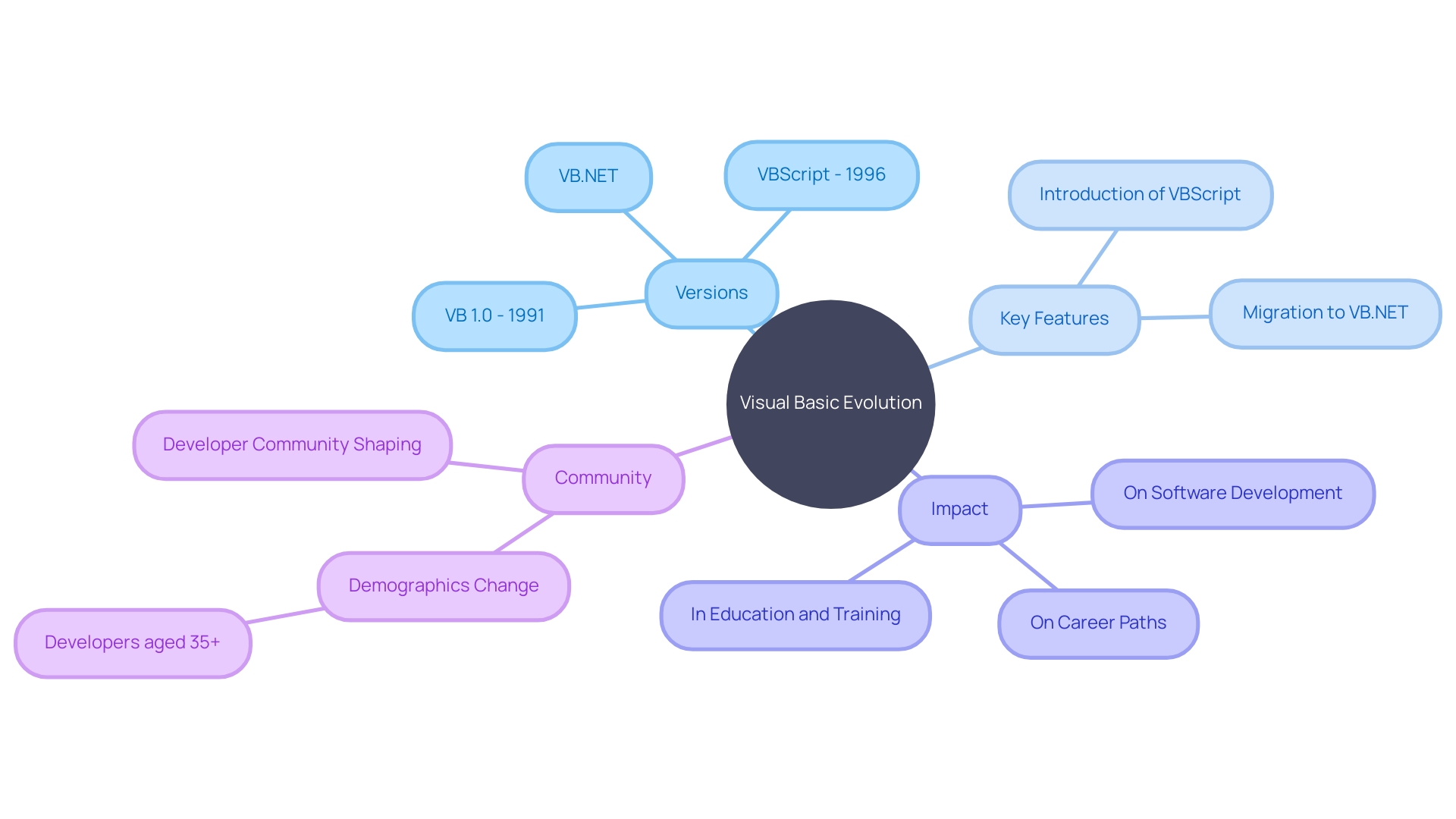
Visual Basic (VB) has markedly evolved since its inception, reflecting the broader growth and transformation in programming technologies. , a watershed version released in 1998, stands as a testament to the language's maturity at the time, offering a suite of features that catered to the then-modern development needs. The advent of Visual Basic.
NET in 2002 brought with it a paradigm shift within the. NET framework, infusing VB with enhanced capabilities, scalability, and the robustness required for sophisticated and large-scale applications. Such advancements underscore the language's journey from a straightforward programming tool to a versatile platform capable of handling complex enterprise solutions, as evidenced by An Post's transition of their STREAMS attendance system from VB6 to VB.NET to future-proof their operations.
Visual Basic (VB) serves as a staple in the software development realm, with its applications spanning multiple sectors. Financial analysts, for example, benefit from VB's user-friendly nature, utilizing it to calculate returns, manage portfolios, and conduct risk assessments with tools like Value at Risk (Var). Var's significance lies in forecasting potential financial losses, which is critical for maintaining sufficient funds to cover such events.
This metric is instrumental for risk managers to adjust their strategies accordingly.
In the healthcare sector, VB simplifies the creation of systems that handle sensitive data and patient management. Similarly, educational institutions rely on VB for developing interactive learning platforms, thanks to its straightforward syntax and approachable learning curve.
Recent news highlights the adaptability of VB, as seen in An Post's migration from VB6 to VB.NET. This intricate process involved updating 194,000 lines of code, enhancing their system's longevity and compatibility with modern infrastructure. to a .NET framework for their loan processing system underscores the importance of staying current with technological advancements, a move that involved reworking over 600,000 lines of code.
The widespread adoption of VB is further evidenced by the sheer number of Microsoft Office users, totaling 1.2 billion globally, who rely on VB for automating tasks in Excel and other Office applications. With the software suite available in 35 languages, VB continues to empower professionals across various industries to optimize their workflows, making it a quintessential tool in the arsenal of both seasoned developers and those just starting out.

In conclusion, Visual Basic (VB) has had a significant impact on software development since its emergence in the early 1990s. Its simplicity and robust features quickly gained popularity among developers, serving as a gateway into the world of programming. VB's user-friendly design has played a vital role in education and training.
As technology evolves, VBScript is being replaced by more versatile options, and legacy systems are being migrated for long-term compatibility. Despite these changes, VB remains a staple in software development, with applications in finance, healthcare, education, and Microsoft Office automation.
The evolution of VB reflects the broader growth in programming technologies. From Visual Basic 6.0 to Visual Basic .NET, the language has matured, gaining enhanced capabilities for sophisticated applications.
VB finds applications in various sectors. In finance, it is used for calculations, portfolio management, and risk assessments. In healthcare, it simplifies system creation and patient management.
Educational institutions rely on VB for interactive learning platforms. Its adaptability is evident in legacy system migrations and task automation in Microsoft Office.
In conclusion, Visual Basic continues to be a valuable tool in software development. Its impact on career paths and its usage in various industries make it an essential language for developers.
Unlock the power of Visual Basic and revolutionize your software development journey today!
What is Visual Basic (VB)?
Visual Basic (VB) is a programming language developed by Microsoft in the early 1990s that enables developers to create Windows-based applications.
When was Visual Basic first released?
Visual Basic 1.0 was released by Microsoft in 1991.
What has made VB popular among developers?
VB's simplicity and robust features have made it accessible and resonant with a wide user base, allowing it to quickly gain a foothold in the development community.
How has VB been significant in education and training?
Visual Basic's user-friendly design has played a significant role in education, with many developers using online resources to learn coding, reflecting a shift towards self-directed education in the digital age.
What are the demographics of the developer community using VB?
While the 25-34 age group remains the largest segment, there has been an increase in developers aged 35 and up, with this age bracket growing from 35% to 39% in one year.
What is VBScript and what is happening to it?
VBScript is a scripting language introduced by Microsoft in 1996, now being phased out in favor of more versatile and powerful languages like JavaScript and PowerShell.
Why are older versions of VB being migrated to new platforms?
Older versions of VB, like VB6, are being migrated to more current platforms such as VB.NET to ensure long-term viability and compatibility with modern technology.
Can you provide an example of a large-scale VB migration project?
An example is An Post, one of Ireland's largest organizations, which migrated 194,000 lines of VB6 code to the .NET environment.
How has VB evolved over the years?
VB has evolved from a straightforward programming tool to a versatile platform capable of handling complex enterprise solutions. Notable milestones include Visual Basic 6.0 in 1998 and the advent of Visual Basic .NET in 2002.
What are some applications of VB in different sectors?
VB is used in financial analysis, healthcare, and education, among other sectors. For instance, it's used to calculate returns, manage portfolios, forecast financial losses, handle sensitive data, and develop interactive learning platforms.
How did An Post utilize VB in their operations?
An Post migrated their STREAMS attendance system from VB6 to VB.NET, updating 194,000 lines of code to enhance system longevity and compatibility.
What does the Vertex Group's transition to a .NET framework signify?
The Vertex Group's transition involved reworking over 600,000 lines of code and highlights the importance of staying current with technological advancements for continued operational success.
How prevalent is the use of VB among Microsoft Office users?
VB is extensively used by 1.2 billion Microsoft Office users globally for automating tasks in Excel and other Office applications, demonstrating its widespread adoption and utility in various professional contexts.