The 'First Then' approach stands as a fundamental technique within Applied Behavior Analysis (ABA), offering a structured method for helping children with autism navigate daily activities with clarity and confidence. By clearly defining expectations—such as "First we will clean up the toys, then we can go outside to play"—caregivers not only ease transitions but also foster a sense of security in their children.
This method, backed by research showcasing a high fidelity of implementation, empowers parents and educators to utilize positive reinforcement effectively, enhancing compliance and reducing anxiety. As caregivers become equipped with essential strategies and insights from behavior analysts, they can cultivate an environment where children thrive, embracing the predictability and support that the 'First Then' framework provides.
Through practical applications and a commitment to consistent reinforcement, this approach transforms everyday routines into opportunities for growth and learning.
The '' method is a fundamental technique in that effectively assists youngsters with autism in . By articulating expectations in a straightforward manner—such as 'First then ABA we will clean up the toys, and then we can go outside to play'— and support. This not only delineates the tasks but also introduces a system of , encouraging young individuals to comply with transitions.
Research indicates that ranges from 80% to 90%, highlighting its effectiveness. , from the University of Social Welfare and Rehabilitation Sciences, emphasizes the importance of such strategies in fostering understanding and compliance among individuals with autism. Moreover, empowered caregivers, equipped with knowledge from , can make informed decisions that enhance their offspring's progress.
The Liu et al. PECS Hospital Study, involving 55 participants, demonstrated the practical application of the 'First Then' approach, where therapists administered the technique consistently over six months. This method minimizes resistance and anxiety, fostering a conducive learning environment and empowering individuals to navigate daily routines with greater ease and confidence.
Through active participation and data gathering, support providers can align their approaches with the insights offered by qualified behavior analysts, ultimately resulting in enhanced behavioral outcomes. Additionally, caregiver education enhances support, allowing caregivers to track progress clearly and personalize strategies to meet their evolving needs.

Reinforcement is essential to the 'Then' approach, serving to encourage desired behaviors by offering a reward upon the successful completion of the initial task. Caregivers equipped with an understanding of ABA principles can implement —such as verbal praise, stickers, or a preferred activity—significantly enhancing the likelihood of compliance. For example, a typical situation includes a young person finishing their homework (the 'Initial') and thereby gaining additional screen time (the 'Then').
This not only incentivizes the initial task but also solidifies the behavior, making it more likely to recur in the future. According to behavior experts, are essential in promoting positive . Current research indicates that in the '' approach significantly boosts compliance rates, particularly among individuals with autism.
By actively participating in their offspring's education and implementing these approaches, guardians can make informed choices that result in enhanced behavioral outcomes. Moreover, offers improved support and alleviates stress, empowering caregivers to manage their offspring's behavior effectively. A pertinent case study titled 'Incident Response Workshop: What Your School Needs to Know and Do After a Cyber Attack' highlights how organized methods can lead to actionable plans, paralleling the structured reinforcement techniques in ABA therapy.
Additionally, Eric Lankford notes, 'Learn how to respond to a cyber incident from minute 1 to 48 months after,' which underscores the importance of preparation and response, similar to how parents can prepare for effective . By comprehending how to skillfully integrate reinforcement into this approach, parents can effectively manage behaviors, support their offspring's development through informed decision-making, and promote a more positive, supportive learning environment.

Applied Behavior Analysis (ABA) is a personalized therapy grounded in the science of learning and behavior, customized to address the unique needs of youngsters. Implementing '' strategies within the framework of ABA provides a structured approach adaptable to various environments, reinforcing this scientific basis. For instance, at home, a parent might say, 'Initially we will take a bath, then we can read your favorite story,' establishing a clear order of expectations that enhances a young one's understanding.
Similarly, in the classroom, a teacher could articulate, 'First we will finish our math problems, then we can have recess,' promoting a predictable routine crucial for effective learning. The use of simple and consistent language is essential, as it helps young learners grasp what is expected of them. , such as charts or cards, significantly enhance comprehension, particularly for non-verbal individuals or those with limited language skills.
Research indicates that these visual supports can effectively bridge communication gaps and facilitate smoother transitions, aligning with the principles of (EIBI) that improve learning, verbal, and social skills in children with autism. As Claire Creaser emphasizes, 'It is well worth spending a little time considering how you will before you design your survey instrument or start to collect any data.' This planning is not only essential in research but also in the practical implementation of 'Then' approaches.
Moreover, anticipating and addressing various , such as low statistical power and violated assumptions, is essential when implementing these approaches in educational settings. By consistently implementing 'first then aba' techniques across various settings, young individuals learn to anticipate alterations in their routine and experience a decrease in anxiety linked to transitions. This consistency cultivates a more , as highlighted by educators who stress the significance of clarity in and the empowerment of guardians through education in ABA principles.
Ultimately, the active participation of caregivers in executing these approaches leads to informed decision-making and enhanced behavioral outcomes for youth, reinforcing the advantages of .

The '' strategy can be a powerful tool for parents, but it often presents challenges, particularly regarding youth resistance and the consistency of its application. A widespread misunderstanding is that youngsters will intuitively understand the 'Initially Then' framework; however, usually necessitates consistent practice and reinforcement. As Sasha Long, M.A., BCBA, illustrates:
So if you don’t let your students play in the break area or jump on the trampoline until they do their low probability behavior – they will be more likely to get it done.
To enhance young individuals' ability to stay on task, it is essential for parents to , making the less overwhelming. Additionally, statistics indicate that if a student is left alone for an hour, they are likely to engage in activities like playing on an iPad or drawing, highlighting the importance of during . Moreover, the case study on literacy teaching for youth with autism illustrates practical uses of the '' approach, highlighting how organized and personalized instruction can be effective in real-life situations.
To mitigate resistance, it is beneficial for parents to begin with as the 'Then' component, thereby enhancing motivation. Consistency in language and expectations across different providers and settings is crucial for ensuring success, as this not only reinforces the learning process but also complements professional interventions that may be in place. Consistently evaluating and modifying the method according to the individual's reactions can enhance the plan, increasing its effectiveness.
By exercising patience and perseverance, supported by a solid understanding of gained through guardian education, parents can skillfully navigate these challenges and foster a more productive learning environment for their children. Improved behavioral outcomes are often observed when caregivers actively apply these strategies, leading to greater success in achieving developmental goals.
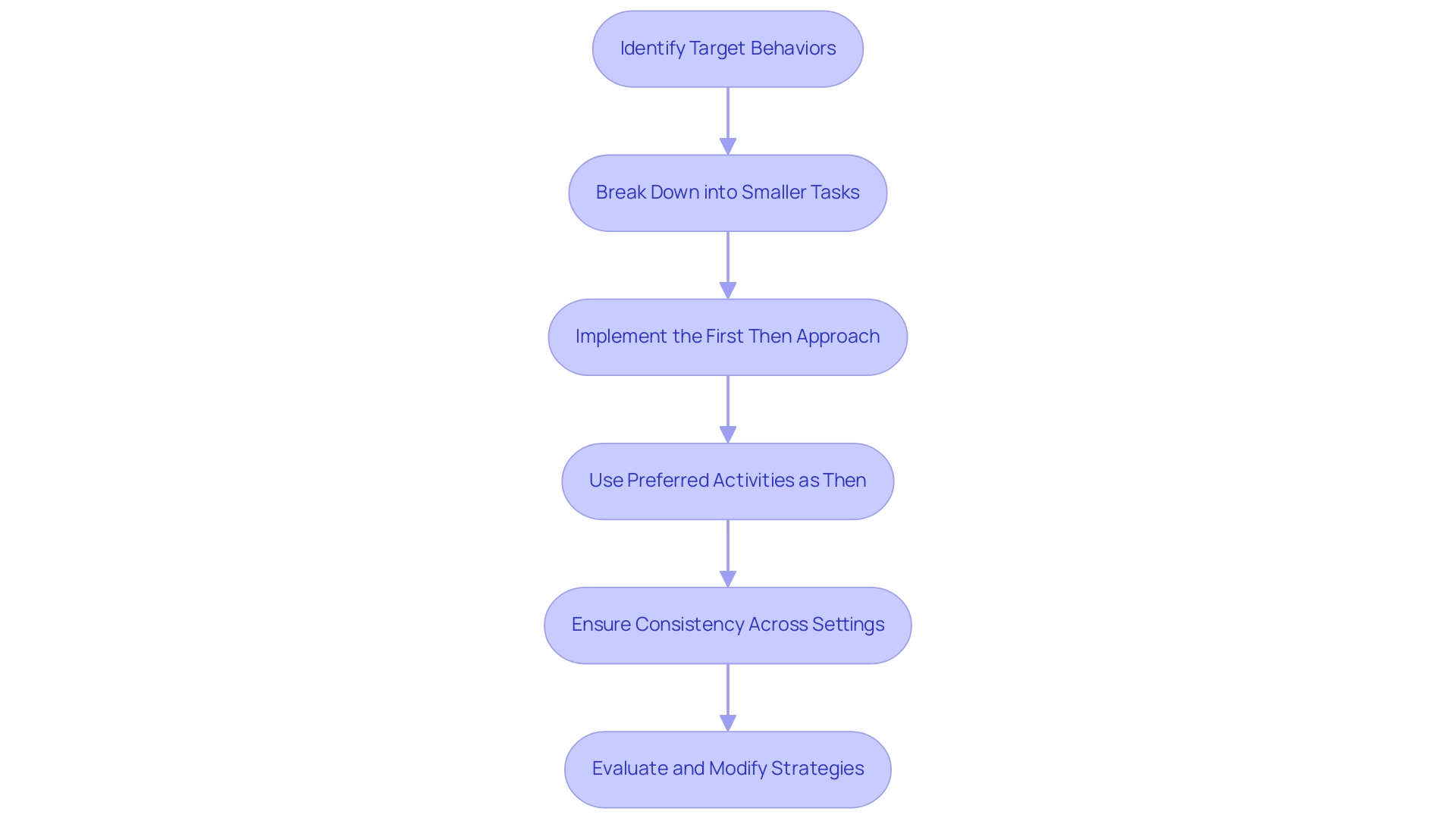
The 'First Then' approach in Applied Behavior Analysis (ABA) is a crucial strategy for caregivers of children with autism, providing clarity and structure during daily activities. By setting clear expectations and using positive reinforcement, caregivers can help children transition smoothly and reduce anxiety.
Reinforcement is a vital element of this approach, as it encourages desired behaviors through rewards for task completion. Effective reinforcement strategies significantly enhance compliance, allowing caregivers to better support their child's developmental needs. This method creates a predictable environment, which is essential for fostering growth.
While challenges like child resistance may occur, they can be effectively managed through consistent application and tailored strategies. Breaking tasks into smaller steps and maintaining clear communication across different settings can help create a supportive learning atmosphere. Additionally, caregiver education is instrumental in refining these strategies, leading to improved outcomes.
In summary, the 'First Then' approach empowers caregivers to promote growth and learning for children with autism. By adopting this structured method, caregivers not only enhance their behavioral management skills but also transform daily routines into meaningful opportunities for development. With consistent application and a focus on reinforcement, children can navigate their environments with greater confidence and ease, setting the stage for their future success.
What is the 'First Then ABA' method?
The 'First Then ABA' method is a fundamental technique in Applied Behavior Analysis that helps children with autism understand the order of activities by clearly articulating expectations, such as 'First we will clean up the toys, and then we can go outside to play.'
How does the 'First Then ABA' method support children with autism?
This method provides clarity and support by delineating tasks and introducing a system of positive reinforcement, which encourages children to comply with transitions.
What is the fidelity of implementation for treatment providers using this method?
Research indicates that the fidelity of implementation for treatment providers using the 'First Then ABA' method ranges from 80% to 90%, highlighting its effectiveness.
What insights do experts provide about the importance of the 'First Then' approach?
Experts, such as Enayatolah Bakhshi from the University of Social Welfare and Rehabilitation Sciences, emphasize that strategies like the 'First Then' approach foster understanding and compliance among individuals with autism.
What did the Liu et al. PECS Hospital Study demonstrate about the 'First Then' approach?
The study, involving 55 participants, showed that consistent application of the 'First Then' method by therapists over six months minimized resistance and anxiety, creating a conducive learning environment.
How can caregiver education enhance the effectiveness of the 'First Then ABA' method?
Caregiver education equips caregivers with knowledge to make informed decisions that enhance their child's progress, allowing them to track progress and personalize strategies to meet evolving needs.
How can support providers improve behavioral outcomes when using the 'First Then ABA' method?
By actively participating and gathering data, support providers can align their approaches with insights from qualified behavior analysts, ultimately leading to enhanced behavioral outcomes.